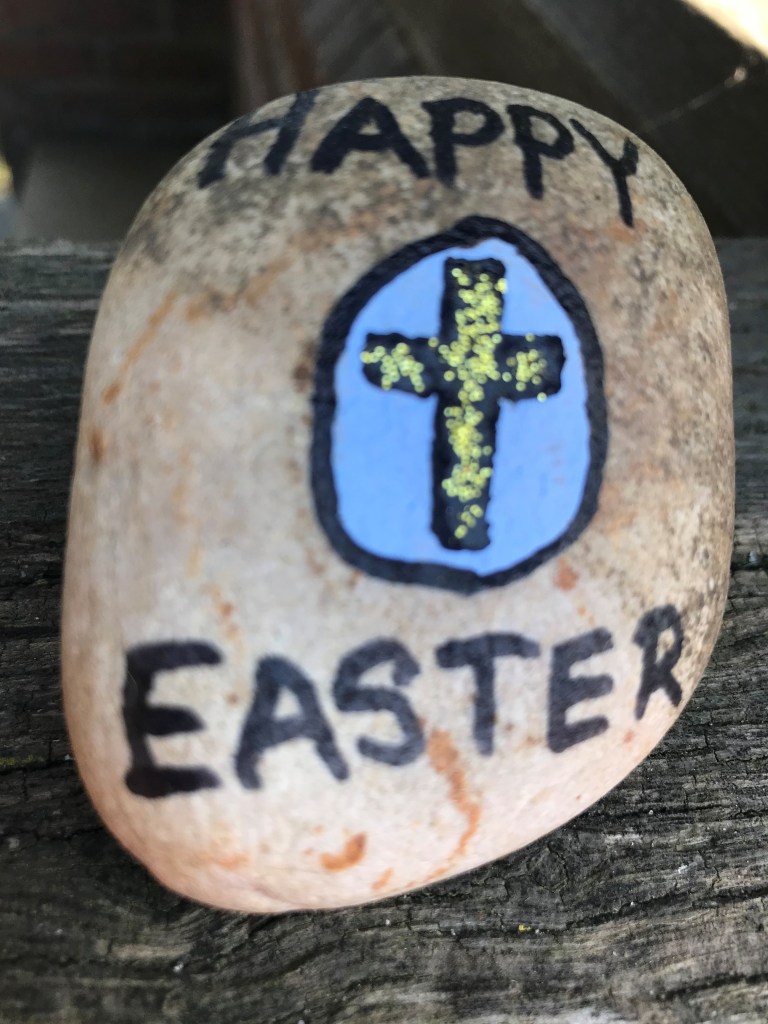
Happy Easter!Memories of Easter Sunday and Easter Monday, real holidays (holy days) when everything is transformed, finally everything comes together and all the waiting is worth it. Childhood lessons in death and resurrection, remembered with much gratitude.
The day dawned bright and early on Easter Day, when everything was made new. The long waiting was over and the clean house on Serlby Rise felt warm and welcoming.
On the polished, dark wood sideboard stood a line of chocolate eggs, wrapped in bright foil and adorned with satin bows.
Why don’t Easter eggs have bows around them anymore?
A special treat was one from my godmother, which had my name iced onto the chocolate. How magical was that?
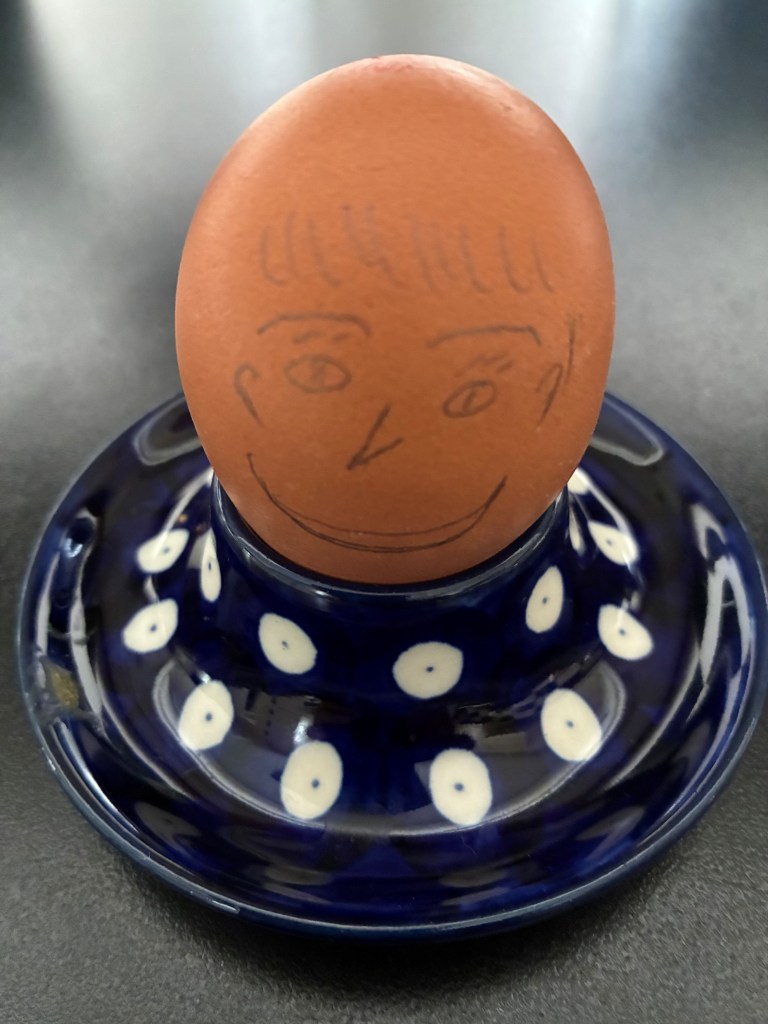
Breakfast was boiled eggs. We all recognised our own egg because dad had drawn cartoons of our faces on them!
Later, we would eat roast dinner and for tea there’d be cakes which mam had baked. That day was a feast day, a real holiday (holy day), for Jesus was alive and everything was made new.
For me, even better than chocolate eggs, personalised boiled eggs, roast dinner and cakes were my new shoes. Easter day was the day I wore my new brown sandals with their lovely leathery smell, shiny buckles and crepe soles. Whatever the weather, this was the day for summer shoes, which I would carry on wearing until September.
I’d known about them for weeks and would open their box, unwrap the tissue paper and delight in their beautiful newness.
When we’d eaten our breakfast, and were washed and dressed as smartly as possible, mam took me to church. There, a miracle had occurred. On Good Friday, I’d been glad to leave the dark, sad, tomblike space to get out into the sunshine, but on Easter Day we walked into dazzling light. The scent of flowers and beeswax hit us first and then the sight of Arum lilies, candlelight and polished wood, brass and silver.
Everything was clean, fresh and bright. The contrast couldn’t have been starker and that childhood lesson has taught me more about death and resurrection than anything I learnt at theological college.
I am so grateful to the women (I assume they were all women) who worked so hard in church to make Easter so real and meaningful.
In our house, the holiday (holy day) didn’t end at bedtime on Easter Sunday. Easter Monday was a day for packing up a picnic and getting into the countryside. It felt and still feels like a very welcome rule that we have to be outside, enjoying spring and new life, whatever the weather and happily for me, it always involved Hot Cross Buns. That’s a rule I’m happy to carry on keeping!
That’s what I’ll be doing this Easter Monday.
What about you? What memories do you have of Easter?
However you celebrate Easter and whatever it means to you, have a very happy and blessed time.
Memories of a childhood Good Friday and Holy Saturday. A fond memory of a friend, church and home and a celebration of Hot Cross Buns! Early lessons which have stayed with me.
The sun was shining on a cold Good Friday in the 1960s. I stood by the post box on Serlby Rise chatting to my friend Coleen.
We were both on our way home from different churches. Coleen had been to St Edward’s (Roman Catholic) and I’d been to St Bartholomew’s (Anglican). I’d walked past our house, to spend more time with Coleen.
At church, I’d joined in a little group of children, walking the stations of the cross, kneeling in front of each picture and giggling when we heard that Jesus was stripped. We had done this every week during Lent, but on Good Friday it was different. The church itself had been stripped of anything beautiful and what couldn’t be moved was covered in black cloth.
I was left in no doubt that Jesus was dead, and this was a sad day. I was glad to get out into the sunshine.
Probably, Coleen had had the same experience and we talked about it. We asked the question why that day is called good when what happened to Jesus was so awful.
Eventually, we said goodbye and went our separate ways. I went home to the longest hours of my life. At home, the house was in turmoil. Mam was cleaning everything to within an inch of its life, all the windows were open, and it was cold and tense.
I recognise this tension in the house when I’m cleaning, and I apologise to anyone affected!
The fish that we ate was lethal with bones.
How come we can buy and eat fish that isn’t full of bones nowadays?
Jesus was dead and buried. The afternoon and next day stretched before me in empty desolation.
There were compensations though, mainly in the form of Hot Cross Buns, which were and still are, one of my favourite foods. Mam was a forgiving mother, but she was very strict when it came to hot cross buns. To eat one before Good Friday was unforgiveable! Thankfully she always provided plenty so we could eat leftovers right up to Easter Monday!
I still have that sense of emptiness through Good Friday and Holy Saturday. For me, the day between Good Friday and Easter Sunday is Holy Saturday, not Easter Eve, because it’s a day in its own right. Having said that, I’ve appreciated being part of churches which celebrate Jesus’ resurrection on Saturday evening!
This year, in 2026, I will wait until 6am to walk up a local hill for our sunrise Easter service.
I’ll publish something to describe the difference a day makes!
In the meantime, have a blessed Holy Saturday.
Wander Well towards Easter (almost there!)
Mandy.
What memories of Good Friday and Holy Saturday do you have?
If you enjoy reading this, please like and subscribe!
An imaginative reflection of Good Friday, weaving in characters and miracles from Jesus’ life. An afternoon when the sun refused to shine and a chill ran through onlookers but when words of forgiveness, compassion, hope and trust were heard.This will be used in a church service, so may read a little differently to other blog posts.
Every public spectacle leaves debris behind. Concerts, rallies, executions, all leave their mark. After the excitement is over and the crowds have gone home, their litter is left for someone else to pick up or to blow across fields and hills, into hedgerows and gardens. Public spectacles do not end without trace.
That Friday in Jerusalem, was no different.
While three men hung dying on crosses, a small crowd gathered. There’d been some jeering, men were in a volatile mood, ready to celebrate their people’s freedom, but as the afternoon became surprisingly dark and cold, they quietened down and shivered.
One by one, they drifted away, earlier than expected. That afternoon, home held more appeal than usual because lamb was roasting, and wine was waiting to be poured.
So, the crowd thinned, leaving picnic remains behind. Bread and fish scattered on the hill outside the city. That day, there was no one to make sure everyone was fed or that the leftovers were gathered up, with nothing wasted.
An older woman felt her recently found energy dropping and she clutched her middle in fear of the old pain returning. There was nothing else to grab hold of. The man who’d called her daughter was gasping for breath and his own energy was bleeding away. The robe which had brought her life and health lay muddied and bloodied, coveted by the gambling soldiers
One man limped away, an old pain returning to haunt him. Weeks ago, he’d sprung up from the ground, picked up his sleeping mat and strode away with Jesus’s forgiving and healing words ringing in his ears, but now he thought he’d have to walk alone.
A young woman’s hot tears spilled down her cheeks. She lived because Jesus had spoken up for her and rescued her from the murderous mob, but no one had spoken up in his defence and from a distance she’d watched the deadly blows that she’d been spared rain down on him.
A man who’d been born blind and another who’d been born deaf covered their eyes and ears and wished they couldn’t see or hear what was happening. The hands that had touched them with healing were nailed to a cross.
Another woman adds to the Holy Week pattern. An imaginative retelling of The Widow’s Mite, in which a woman makes her way to the temple on a busy day and reflects on her advancement in life. S
She walked steadily through the busy city streets. She knew her way around and avoided being shoved out of the way by earnest pilgrims who were looking out for family and friends, carrying luggage or buying food for the feast. She kept her head down when she passed yet another group of soldiers taking up more room than they needed to. Not that she was worried; she’d got used to being invisible. That’s what being older and widowed did for you. She’d also got used to making every penny she had work hard for her.
As she climbed up the hill to the temple, she couldn’t help but remember other Passovers, when, with her husband and children she almost ran, singing psalms I was glad when they said to me, “Let’s go to the temple of the Lord.” (from Psalm 122) and laughing with excitement.
That sort of happy excitement felt like a dimly remembered dream, but she anticipated the festival with a quiet certainty and under her breath muttered a different psalm Do not reject me when I am old; do not leave me when my strength is gone. Even though I am old and grey, do not leave me, O God. (from psalm 71).
When she arrived at the outer temple courts, she instinctively drew herself in. She was used to a barrage of men selling doves for sacrifice, and she had no intention of handing over her money in exchange for some poor creature doomed to die. Still, she was surprised by the quiet spaciousness in that court. Unusually in festival week, there was space to breathe and to pray.
She had heard rumours about a travelling rabbi from Nazareth who’d lost his temper with the temple traders and thrown them out. She’d heard other rumours about him too, about good teaching, feeding and healing and was surprised he’d been so angry. Still, if it meant there was more space for pilgrims that week, then that was good.
She walked on into the court of the women. That was as far as she was allowed to go, but it had what she wanted. She reached into her purse and found two small copper coins. She’d worked out that if she broke her fast later that day and accepted her neighbour’s invitation to share their Passover meal, she could afford to give them as her festival offering. They barely clinked when she threw them in the treasury box and she breathed a prayer that they would be turned into food for the poor.
Before she’d finished, she heard the murmur of a group of men walking past and caught the scent of expensive perfume. Then, she heard clearly one man’s voice and realised she was no longer invisible.
Jesus said: “I tell you the truth, this poor widow gave more than all the rich people. They gave only what they did not need. This woman is very poor, but she gave all she had to live on.”
She raised her head and saw that his hand was stretched towards her, and he was looking her in the eye. She knew that God had answered the prayer of the psalm and not rejected her.
This story is sometimes called the widow’s mite, but I wonder if we should rename it “The widow’s might!” She seems like a mighty strong character to me.
I wonder how she fits into the pattern of Holy Week. Certainly, she was an example to help Jesus challenge the establishment and ideas of greatness. What if there was something more? What if she gave him a fresh memory of goodness when he was surrounded by evil?
Go well towards Easter,
Mandy.
You can read this Bible story in Mark’s Gospel chapter 12, verses 41-44.
If you enjoyed reading this, please like and subscribe!
In which Jesus takes a break from Jerusalem and visits a friend in Bethany. There, an unidentified woman anoints his head with very expensive perfume. This is a beautiful, caring, soothing gift but she is criticised and what she did shook things up again. Was this a bit of the week’s pattern which just didn’t match up?
The house in Bethany was warm and comfortable. The scent of bread and spiced lentils filled the air, mingling with warm oil when the lamps were lit. Simon, the host, prayed the evening prayer and blessed the light and the food, then with a grateful sigh, the men took their places at the table.
Walking the two miles from Jerusalem at the end of a long day had been worth it. The city crowds were oppressive. Everyone was ready to celebrate Passover and passions were running high. To mark the festival of freedom, the Roman governor Pontius Pilate had moved into town with military reinforcements, and they were making their presence felt. Talk about irony!
However much they wanted to leave the tension behind, of course they carried it into the welcoming house with them. Their conversation was brief and they looked from one to another to see if anyone had a clue what was going to happen next.
Eventually, they looked to Jesus, who must have been wearier than all of them. In a few days, he had arrived in Jerusalem, wept over it, looked around at everything, driven money changers out of the temple and taken his place there as teacher, giving out some hard lessons. He even said that the temple would be destroyed. He must have been goading his opponents. Surely this was the time for decisive action, the time some of them had been waiting three years for.
Thank God he had friends in Bethany. Surely, while they were safe in this house, he would tell them what to do next and how the pattern of this week would fit together.
Still, Jesus kept quiet, breathed in the peace and quiet and enjoyed the food.
Until that is, a draught cooled the air and a new scent entered. Simon looked up first to see who had entered his house and a flicker of recognition crossed his brow. He smiled to welcome the woman but stood up to stop her when he saw what she was doing.
The men around the table gasped when they heard the crack of alabaster and smelt the beautiful perfume which was poured over Jesus’ head. Quickly, they were all on their feet, apart from Jesus, who relaxed and smiled his first smile for a long time.
The scent of spices, oil, and shocked, tired bodies gave way completely to that perfume. The whole house was filled with it.
The horrified silence soon gave way to muttering, which became angry outbursts. It was hard to put their fury into words, so it came down to money. What we spend our money on is always an easy target for criticism.
“That perfume was worth a full year’s work. It could have been sold and the money given to the poor.” Mark’s Gospel chapter 14 verse 4.
Little did that woman know that for millennia to come, men would still be arguing about that and condemning her as immoral just because she had a valuable possession!
Still, Jesus spoke then in her defence. What a beautiful thing she had done. In that week of tension and danger, that woman gave all she had to comfort and soothe Jesus. He recognised that this was a preparation for his death. Maybe she was the only one in the room to get what was happening.
This was a piece of the pattern which just didn’t fit for some of the disciples. The group got a bit flakier.
A woman’s loving generosity and understanding didn’t fit the pattern and threatened the expectations of the men who were closest to Jesus.
What I wonder is this: did that beautiful perfume cling to Jesus through the rest of the week? In the middle of terrible cruelty, did that perfume act as a reminder of an act of kindness?What do you think?
Wander well towards Easter,
Mandy.
You can read this Bible story in Mark’s Gospel chapter 14 and Matthew’s Gospel chapter 26.
If you enjoyed reading this, please like and subscribe.
In which I struggle to make a paper cross and realise the Holy Week events didn’t match up for the people involved. Remembering Jesus getting angry and how that might have encouraged opposing parties and supporters alike. A poem from Mary Oliver with a reminder to pay attention.
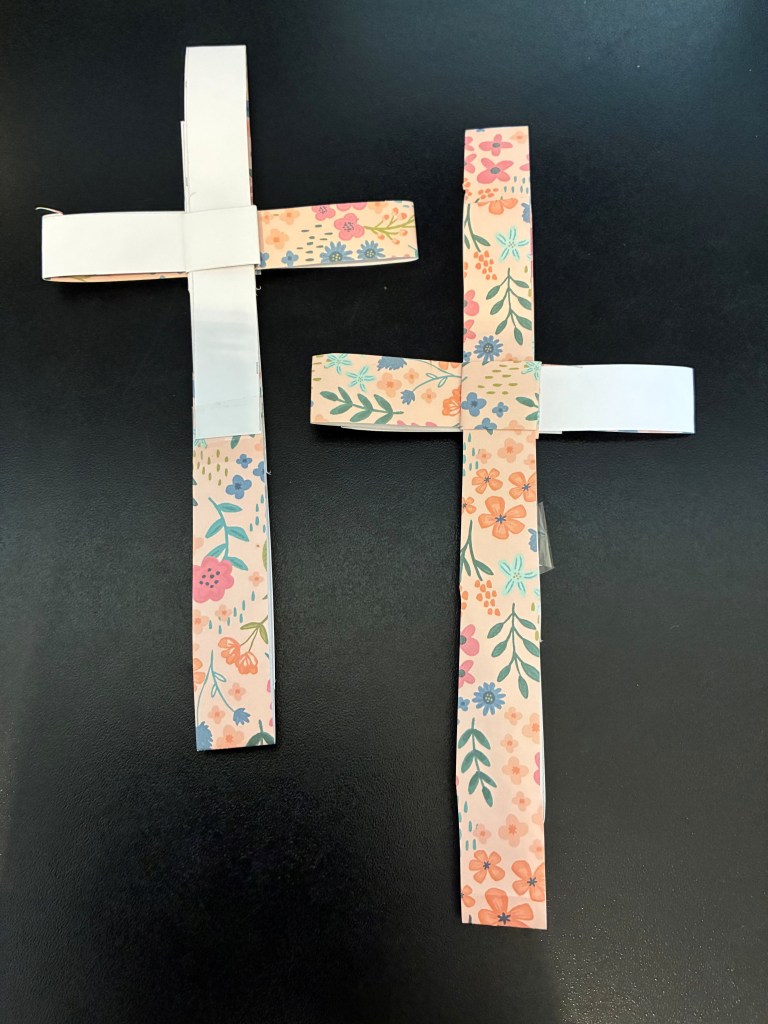
At a day of preparation for this week which to me is holy, we made paper crosses. We used paper which was white on one side and patterned on the other. The making involved folding, which meant we ended up with plain white bits clashing with patterns and flowers hanging upside down!
This was frustrating, exasperating, irritating, even anger making. We questioned if we would ever get it right and were tempted to give up before we’d hardly started.
Maybe the lesson was in the trying. We were about to begin a week of meditating on stories which are hard to match up, even though we’ve had 2,000 years of making them fit.
When Jesus arrived in Jerusalem, with a jubilant crowd cheering him on, he cried over that city. How did that fit for anyone feeling triumphant?
When he visited the temple, he got angry (I mean angry – he overturned tables and used a whip!) He drove out anyone taking up prayer space and making money out of worship.
Maybe that did match up; both for the revolutionaries who were ready for violence and the religious authorities who believed Jesus was a threat to the establishment and to them, but that was just the beginning of the week. There were more surprises in store.
Read about Jesus getting angry and cleaning the temple in the Bible:
Matthew 21:12 – 17 Jesus clears the temple and leaves Jerusalem for Bethany.
Mark 11:12-17 Jesus curses a fig tree and clears the temple.
Luke 19:45- 48 Jesus clears the temple.
Sometimes it’s worth sticking with something, even when it looks like it’s never going to match up!
Here’s a poem by Mary Oliver, which reminds us again to pay attention.
Praying.
It doesn’t have to be
the blue iris, it could be
weeds in a vacant lot, or a few
small stones; just
pay attention, then patch
a few words together and don’t try
to make them elaborate, this isn’t
a contest but the doorway
into thanks, and a silence in which
another voice may speak.
Mary Oliver, from her book “Thirst.”
What have you seen today which is a doorway into thanks and a silence in which another voice may speak?
Wander well towards Easter.
Mandy.
If you’ve enjoyed reading this, please like and subscribe.
Seaside memories and the importance of donkeys. Palm Sunday processions and arriving in peace despite all expectations.
The hot, sandy pavement pressed hard against my feet that summer afternoon at the end of a long day playing on the beach at Mablethorpe. My beach shoes (plimsolls) rubbed against my sore feet which were still cold and damp from paddling and castle building and tiny, gritty, sharp grains bit into my toes, but still I walked on, holding my dad’s hand.
We had to find a good spot with the best view, because dad had looked forward to this all day.
Here they come, he said, look, they’re running because they’re happy. They’ve finished work and they’re going home to their field.
With a clattering of hooves and a scent of heat, dust and sweat, the beach donkeys trotted past. They’d spent all day plodding up and down a stretch of beach carrying children of every size.
Later in the evening, we would walk further away from the beach, where the grass grew lush, to find the donkey field, the place where they rested before another day’s toil.
This was important for my dad. He cared about donkeys. When he was a boy, his mother took the whole family to Scarborough for the summer, where she rented a house and took in paying holidaymakers. None of the family knew where they would sleep each night and everyone had a job. Dad’s job was to work with the seaside donkeys. No wonder he felt sorry for them and taught us to care about them.
In retirement, he “adopted” two donkeys at the Bransby Home of rest for horses. They were called Moab and Dylan, and it was a treat for his grandchildren to visit “Grandad’s Donkeys.”
He wasn’t a great churchgoer, but he loved Palm Sunday, when a donkey took pride of place in the story. Sometimes, a real live donkey led our procession through Nottingham streets.
I am sad to know that this year, 2026, there won’t be a Palm Sunday procession along the original route into Jerusalem. Jesus had better freedom of movement than current Palestinians.
Donkeys play an important role in the Bible.
A man called Balaam had a wise donkey who saw an angel before his master did, then found a voice to warn him with. This averted disaster and turned a curse into a blessing.
A man called Saul was sent to look for his father’s lost donkeys and found the prophet Samuel, who chose him to be king.
When a king approached a city riding on a donkey, it was a sign that they were arriving in peace, and Jesus arrived full of peaceful intent, though some of the crowd cheering him on probably wanted something different.
Father Patrick Van Der Vorst says this about the donkey which Jesus rode:
The donkey was not swayed that day in Jerusalem by the joyful acclamations, nor later by the screaming words of hate. The donkey did a particular job, which was to bear a particular burden. It did this, humbly, not expecting praise or reward.
I suppose the same could be said of Jesus. He wasn’t swayed by cheers, jeers or false accusations. He carried on being himself.
How would we like to see a leader with peaceful intentions, not swayed by popular opinion?
Here’s a poem by UA Fanthorpe which takes us back to Christmas but looks ahead to Palm Sunday:
What the Donkey Saw.
No room in the inn, of course, And not that much in the stable What with the shepherds, Magi, Mary, Joseph, the heavenly host – Not to mention the baby Using our manger as a cot. You couldn’t have squeezed another cherub in For love or money.
Still, in spite of the overcrowding, I did my best to make them feel wanted. I could see the baby and I Would be going places together.
The summer journey from York to Scarborough was a quick and pleasant drive along the A64. The sky was blue and the air was fresh when we parked the car and found our way into our accommodation. We’d booked a traditional seaside hotel, with a traditional seaside landlady who filled us up for the day with wonderful breakfasts (when I chose the vegetarian option, I got twice the amount of food in case I wasted away through lack of meat!).
As well as feeding us well, she took charge of her guests from the first tentative phone call until the day we left. The hotel was perfectly situated in the north bay. To our right was Scarborough Castle, behind us was Scarborough Cricket Club and in front was the sea.
I could hardly contain my excitement because we’d booked a sea view room.
Once in, we lugged our suitcases up one flight of stairs after the other until we made it to our attic bedroom with a window high above me. Thankfully, there were high stools, so I carried on climbing until at last I got my sea view!
Straightaway, I decided to get out my notebook and just write down what I could see through the window, and I did that every day of the holiday.
This was a new idea to me; it was a bit like painting a picture with words and I was fascinated by what happened.
I began by writing something like I can see the sea and there are people walking past but it progressed to there’s a woman in a red coat walking a dog. She seems to be in a hurry and impatient when the dog wants to stop. There’s a man who seems to be struggling to keep going and there’s a couple who have been talking so long that their dogs can’t sit still and are pulling at their leads. Whole stories were being played out in real life in front of my very eyes.
The sky took on a life of its own. Clouds changed shape and colour. The sea came to life. Waves rose and fell, danced, crashed and rippled. There was a whole lot of world out there!
I didn’t spend an entire week looking out of the window! I had a really good holiday and I love Scarborough, but looking at the same view and taking notes had a powerful effect on me. I live in a distracted world with images flashing at me all the time and I can easily miss what is actually going on. Learning to stop, really look at something and write down what I saw helped me.
Taking time to do this can be a precious gift especially if, like me, you have constant narratives going on in your head all the time. Do you know what I mean? Different scenarios and what if this happens or she says that or it rains …. The possibilities which our minds can conjure up are endless, aren’t they?
It can also help us when we meet other people. Everyone makes a quick impression about how we’re feeling, how tired, happy or sad we are and if we learn to focus our attention by spending time gazing out of a window, we can learn to go beyond those quick first impressions.
Looking through a window is a good place to start, because the view is literally framed!
As well as looking carefully at a view, a flower or the people you meet (don’t start making notes on them, it won’t go down well!), when you read a book, slowing down and looking carefully at what you’re reading is a good idea.
For me, the week before Easter is holy and full of Bible stories which are a feast for all the senses. I’m going to try and take time to really concentrate on them and make notes. I might share on here what I come up with.
How are you going to spend the week before Easter? Will it involve a notebook? I’d love to hear!
Wander well,
Mandy.
Things I love:
The Seaside.
The Yorkshire Moors.
The East Coast of England.
If you enjoyed reading this, please like and subscribe!
Roller coaster memories of the first Covid – 19 lockdown in England, with shock, anger, fear, worry, kindness, sadness, gratitude and admiration.
You can’t do that!
Once, there was a vicar of a group of English villages with eleven churches who shouted at the radio “You can’t do that!” she wasn’t prone to shouting at newscasters, so why yell that day? The reporter had announced plans to forbid everyone over seventy years old from going outside. It wasn’t a dystopian nightmare; it was real life unfolding in March 2020. The deadly Covid 19 virus invasion was underway. We needed a battle plan.
Lockdown.
Seventy-year-olds weren’t banned from leaving their homes, but on March 23rd at 8:30pm a full lockdown was announced by Prime Minister Boris Johnson. We had to stay home immediately, even though lockdown didn’t take full effect till March 26th, which led this vicar into lasting confusion.
Rules about church took time to clarify. Custodians of church keys dashed to and from their beloved buildings, unlocking and locking doors with each changing instruction. Weekday services were set up then cancelled following the decree that church lockdown wasn’t just for Sundays.
The vicar, along with everyone else had to reinvent her life. Church would carry on, but not as anyone knew it. Overnight, she went from being surrounded by people morning, afternoon and evening, to wondering how to maintain contact, care and worship.
Kindness.
Straightaway, kind, encouraging messages flowed to her. Friends posted her chocolate as soon as churches were closed. Another friend promised a weekly Sunday afternoon phone call and kept that promise. Jolly John Rutter music arrived, sent from a churchwarden. The doorstep became a place of gifts; eggs, beer, flowers …
One day a group of ducklings arrived at the front door. They’d got separated from mother duck and the kindly, traffic free road allowed them to waddle across safely.
You Tube is for everyone!
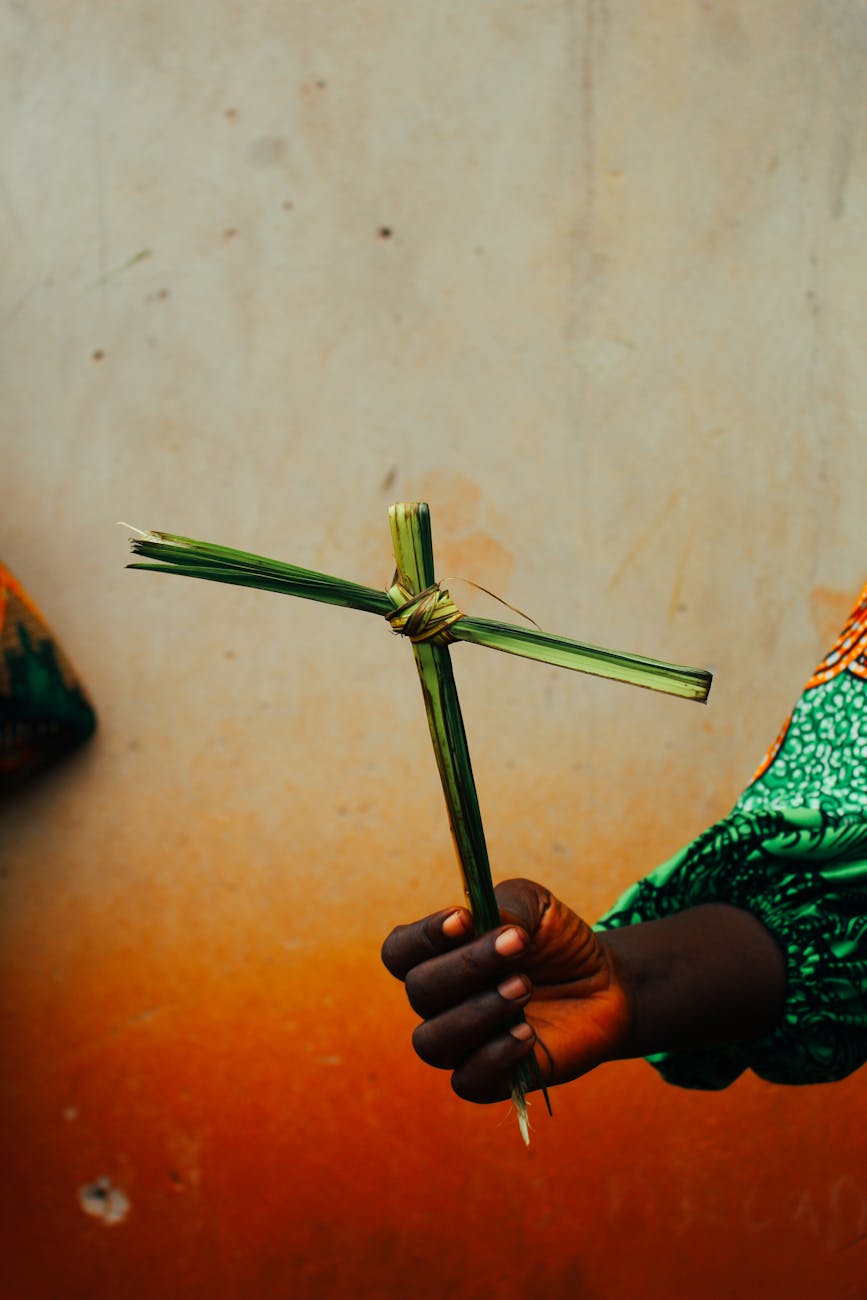
Classed as a key worker, she needed and wanted to keep going. The villages needed a vicar. With the help and encouragement of her husband and son (ie, you’ve got to do this, you haven’t got any choice!) she set up a You Tube channel and published films of services from her study, along with hopeful messages, children’s stories and Easter activities. Yes, if you search You Tube hard enough, you will find a video of her demonstrating how to make a Palm Cross from paper!
Along with everyone else, she was hurtled out of every comfort zone.
Unmute!
This vicar had never used any video calling system, but Zoom became a lifeline for meetings, evening prayer, Bible study and entertainment.
She looked forward to weekly family quizzes, friendly get togethers and Pilates classes. In the summer, she celebrated their ruby wedding anniversary on a family zoom to which everyone wore the grandest hats they could find!
Working via video, zoom and telephone was hard work. Conversations were not shared in the same way; the vicar couldn’t read the room or sense how someone was by the way they arrived or where they sat. She hopes that those things aren’t lost now that we’ve adopted online meetings as normal.
Sadness and anxiety.
Covid 19 brought with it disease and death, isolation and fear and this vicar felt shock, sadness and anxiety.
My flesh and my heart may fail, but God is the strength of my heart. Psalm 73
What was sad?
Funerals where she hadn’t been able to visit the family and which were attended by very few people, sitting far apart and not being able to talk before or after the service.
Postponed weddings. Who wanted to get married with only three people in attendance?
Talking to a man on the phone while he sat in the hospital car park where his wife was dying. That was the closest he could get.
Very vulnerable people living alone while their health, mobility and confidence declined.
Awareness of so much suffering.
She was anxious about her children, who were all key workers.
She was helped by this verse from psalm 73, which she made her Covid motto:
“My flesh and my heart may fail, but God is the strength of my heart.”
Awesome admiration.
The vicar was bowled over by the wonderful church and community spirit. Straight away, things got organised.
Village coordinators made sure that everyone was in contact.
Shopping and prescriptions were delivered.
Pubs delivered meals on wheels.
Mothering Sunday flowers and cards appeared on doorsteps.
Church craft and story kits were delivered to children.
Hospital scrubs were sewn.
Easter gardens and decorations appeared in churchyards.
Countless phone calls were made.
Gratitude.
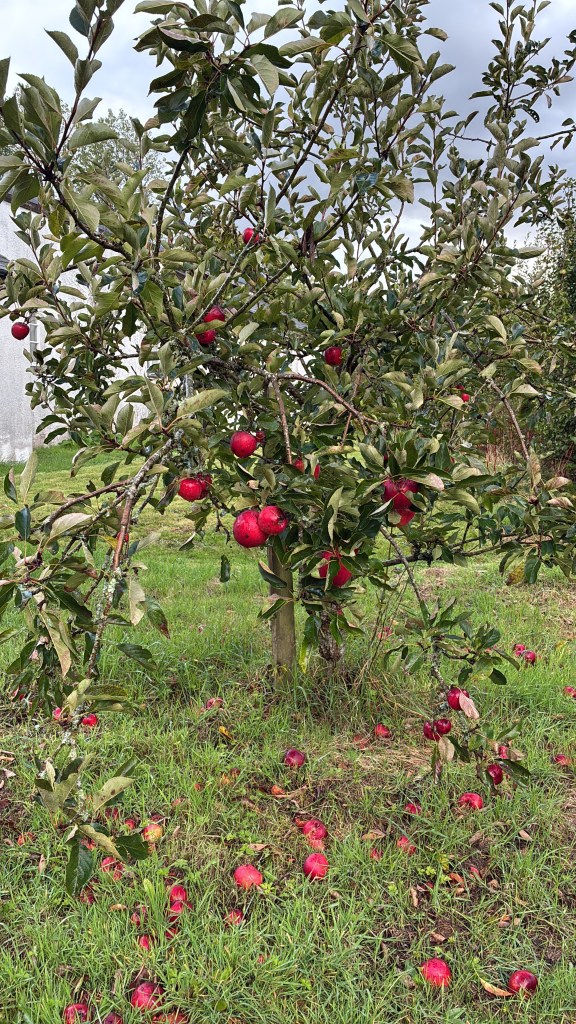
This vicar knew she had it easy. She lived in a vicarage with a big garden. The weather was beautiful in those early lockdown weeks, and she had plenty of good, green places to walk. In the Vicarage garden was an apple tree and she would arrange drinks and dinner dates at “Ye Olde Apple Tree!”
No prizes for guessing that this vicar is me. It’s been quite emotional and difficult to write this. I wonder if we’ve even begun to realise the effect that lockdown had on us.
I want to express my sincere thanks and admiration for The East Trent Group of Churches, who kept church alive and cared for so many people with cheerfulness and creativity.
I’ve only talked about the early weeks of lockdown; there is so much more I can say about what happened later on!
Thank you also to my family and friends, who’d have thought we’d live through that?
Now, in retirement, I wonder what I would volunteer to do if it happened again? If I’m allowed out that is! What are your thoughts and memories of lockdown?
Where shall we wander next?
Wander well,
Mandy.
Things I love:
Warm spring weather.
Ducklings.
Open churches.
If you’ve enjoyed reading this, please like and subscribe!
The cold March wind whipped around corners and between houses and bit into my bare knees and face when I walked home from school for my dinner.
That day, I guessed the house would be empty, and I guessed right. I went through the back gate and looked into the garden to see towels flapping in the breeze and mam wrestling bed sheets onto the clothesline.
It was Monday and Monday was washing day.
Do you know why Monday was washing day?
Factories didn’t work on Sundays, so by Monday the air was slightly cleaner and better for drying clothes!
I rushed to help get the sheets on the line and before I went back to school, I would get them in and hang some more out. The sky was bright blue, with little white clouds scudding along, so it promised to be a good drying day and in our house that meant a good week.
What were Mondays like when you were at school?
The Twin Tub.
The Monday kitchen was a humid, damp place smelling of washing powder and long green bars of soap, used for scrubbing shirt collars and cuffs. The height of washing luxury for my mam was a twin tub, which was dragged into place and filled by a hosepipe from the kitchen tap. Laundry went into the soapy water in a strict order; whites first, progressing to towels last. When each load was done, mam used a pair of wooden grabbers to lift everything into the spin dryer, which she filled with cold water. When the dryer lid was pressed down, it switched on the motor which rinsed and spun water out through another hose pipe which we held over the sink. If it wasn’t loaded properly, the whole machine jumped around the kitchen floor.
Thus, once a week the whole family’s clothes and all the household linen got washed!
Strange that with all our labour-saving devices, nowadays the washing is never finished!
Monday Dinner.
Everywhere was dominated by washing. There was nowhere to sit, no empty surfaces and no towel to dry our hands on. Monday food was tasty and predictable. We ate cold meat left over from the Sunday roast with bubble and squeak – fried up left over potatoes and cabbage -followed by rice pudding. Rice pudding was quick and easy to prepare and could be left cooking in the oven without needing any attention.
Comfort Food echoes down the ages.
When I was six, mam went into hospital and I was looked after by my eighteen-year-old sister. Every day she cooked rice pudding for me. That was the only food I said I liked and it’s real comfort food!
When our children were young, every Monday we ate baked potatoes and rice pudding. This wasn’t so that I could concentrate on washing, but so that we could go swimming after school and get home to ready cooked hot food!
Washing dominates.
When I was a student nurse, I was irritated by older women who spent their breaks fretting about if their washing would dry. Is that all they care about? I thought, I would never get like that, but I grew up into just such a woman!
About forty years later, I was walking home to the Vicarage. It was a beautiful, bright day and I hoped to put some washing out before my next appointment.
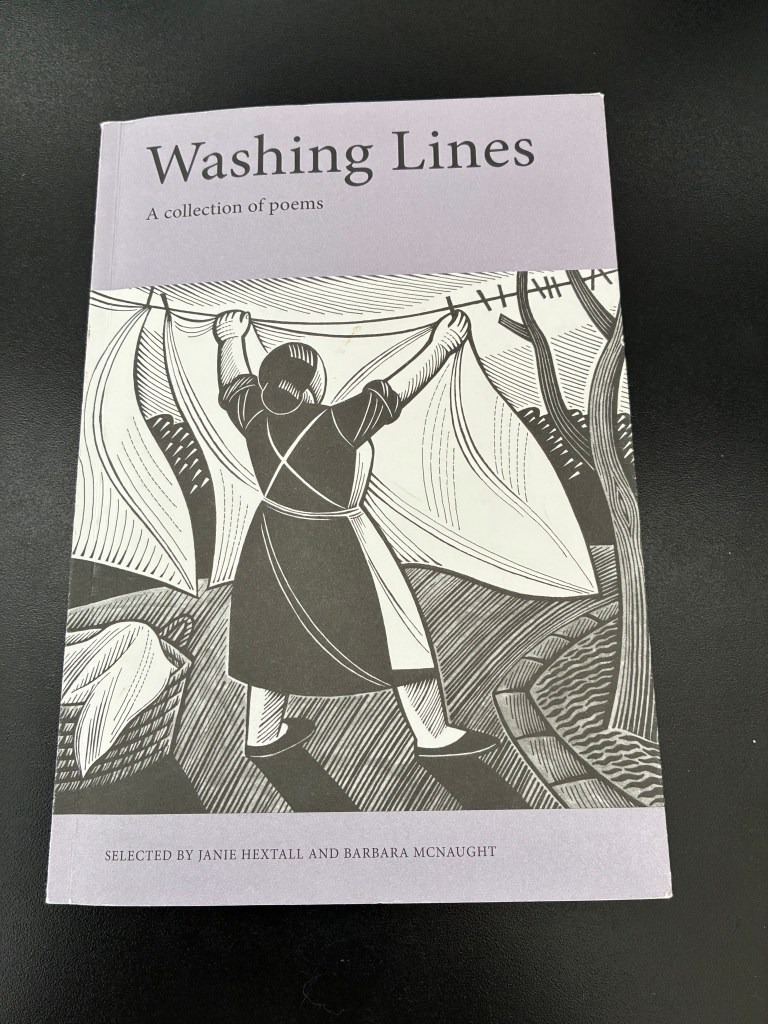
Because I was thinking about washing, imagine my surprise when I opened the door to find a parcel. A gift from a friend. It was a book called Washing Lines, a collection of poems collected by Janie Hextall and Barbara McNaught. My friend’s mum was having a clear out and they thought I would like it.
It’s delightful and here’s a favourite poem of mine:
I stop writing the poem
to fold the clothes. No matter who lives
or who dies, I’m still a woman.
I’ll always have plenty to do.
I bring the arms of his shirt
together. Nothing can stop
our tenderness. I’ll get back
to the poem. I’ll get back to being
a woman. But for now,
there’s a shirt, a giant shirt
in my hands, and somewhere a small girl
standing next to her mother
watching to ssee how it’s done. This is written by Tess Gallagher.
Here’s a quote from “Laundry” by Ruth Moose, which is so good!
There is joy in clean laundry.
All is forgiven in water, sun
and air. We offer our day’s deeds
to the blue-eyed sky, with soap and prayer,
our arms up, then lowered in supplication.
What memories of washing day do you have? I’d love to hear about them!










































 Wandering Through The Land Of Nod.